
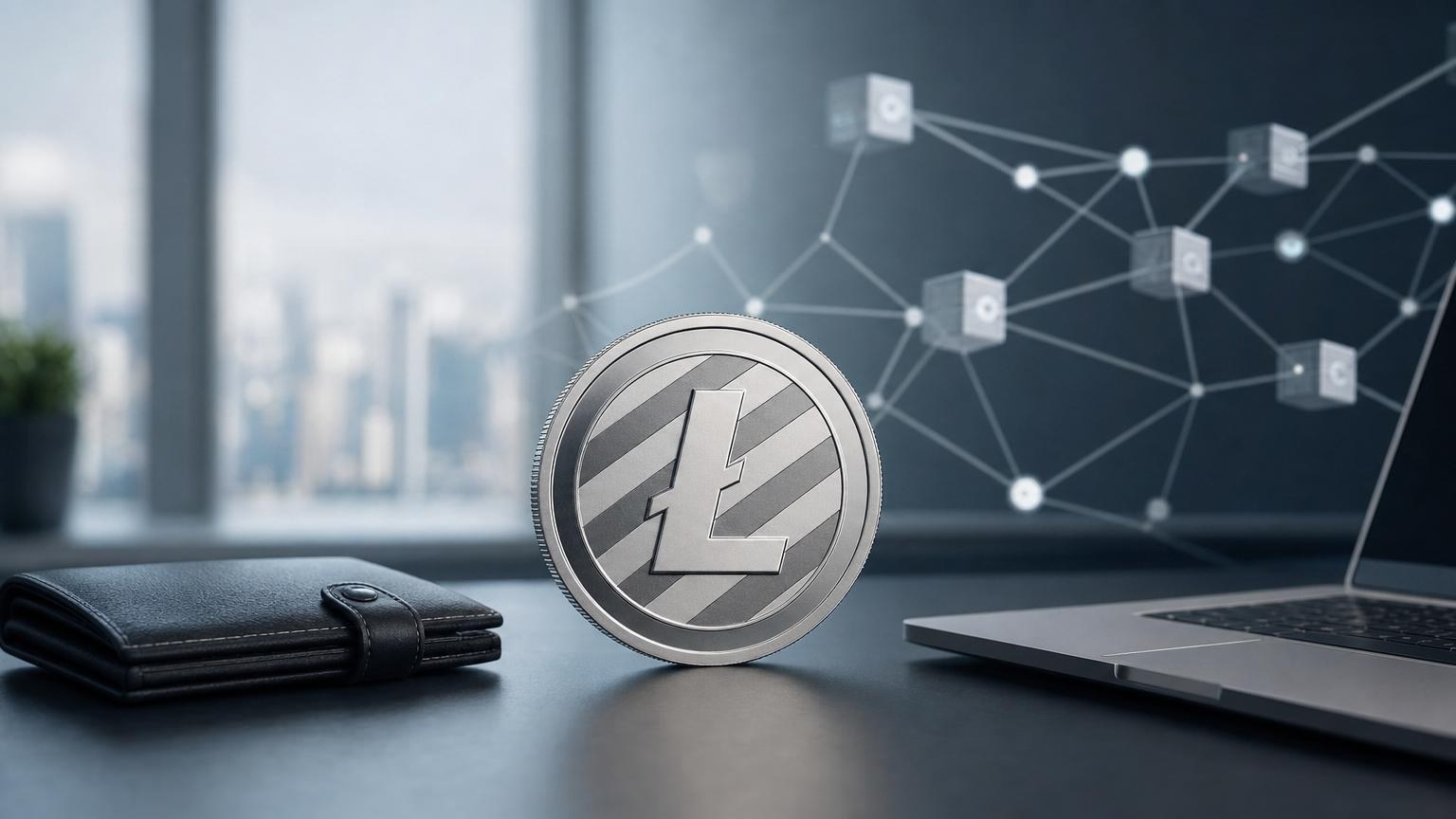
Litecoin is a peer-to-peer payment network, while LTC is the native coin transferred and used to pay transaction fees on that network. It is designed primarily for moving digital value without a bank operating the ledger. This guide maps the concepts needed to understand Litecoin, assess a practical transfer, or explore how the protocol works. It does not predict the price of LTC or treat the asset as suitable for every person or payment.
A compact map of Litecoin
The topic can be organized into five connected nodes:
- Purpose: what Litecoin is intended to do and how LTC fits into the system.
- Network mechanism: how transactions reach miners, enter blocks, and gain confirmations.
- Practical use: when LTC may be used for transfers, payments, exchange, or self-custody.
- Limitations: volatility, irreversible transfers, compatibility gaps, custody risks, and changing service requirements.
- Verification: what to check in a wallet, explorer, exchange interface, and local rules before acting.
The relationship is straightforward: digital payment asset → proof-of-work network → transfer or payment → operational and market risks → independent checks before sending.
Route 1: Understand Litecoin quickly
Read the purpose node, the plain-language transaction model, and the comparison boundaries. The expected result is an ability to explain the difference between Litecoin, LTC, a wallet, and an exchange without going into protocol engineering.
Route 2: Prepare for a practical action
Read the transaction lifecycle, use cases, wallet and address checks, confirmation guidance, and risk checklist. The expected result is a safer process for receiving, sending, or exchanging LTC without assuming that every wallet, address type, or trading direction is supported.
Route 3: Understand the technology
Read the proof-of-work, block, UTXO, supply, and MWEB nodes, including the expandable technical notes. The expected result is a working model of how Litecoin records ownership and reaches consensus, along with a clear view of what its privacy option does not guarantee.
Purpose: what Litecoin and LTC are
Litecoin is an open-source blockchain network based on a model closely related to Bitcoin. It has its own ledger, nodes, miners, consensus rules, addresses, and native asset. Official Litecoin documentation identifies several distinguishing parameters, including an approximately 2.5-minute target between blocks, a maximum supply of 84 million LTC, Scrypt proof of work, and the optional MimbleWimble Extension Block feature known as MWEB. [1]
Litecoin can mean the network or the broader software project. LTC means units of the native coin. Litecoin Core is software that can participate in the peer-to-peer network, validate the blockchain, and manage a wallet; it is not the network itself. [1]
LTC is not merely a database entry held by one company. Ownership is represented through cryptographic keys and transaction records distributed across the network. A wallet helps create and store keys, construct transactions, and display balances. Depending on the product, those keys may be controlled by the user or held by a custodian.
This distinction changes the risk model. With a self-custody wallet, losing the recovery phrase or private keys may permanently remove access to the coins. With a custodial service, access also depends on the provider’s security, operating status, withdrawal rules, and compliance procedures.
What Litecoin is not
- It is not a stablecoin, so its market value can rise or fall relative to national currencies.
- It is not a bank transfer and normally cannot be reversed by calling an intermediary.
- It is not automatically private: ordinary Litecoin transactions use a publicly inspectable blockchain.
- It is not the same as a Litecoin balance represented on another platform or network. A service may use an internal ledger or a wrapped representation, so the withdrawal network must be checked separately.
- It does not guarantee acceptance. A recipient, wallet, merchant, or exchange must explicitly support the relevant Litecoin transaction and address type.
Network mechanism: how an LTC transaction works
A standard transfer starts when a wallet constructs a transaction specifying which available coins will be spent and where the outputs should go. The sender authorizes it with the appropriate private key. The wallet then broadcasts the signed transaction to the Litecoin peer-to-peer network.
Nodes check the transaction against protocol rules. Miners select valid transactions, arrange them into candidate blocks, and perform proof-of-work calculations. When a valid block is accepted by the network, the transaction receives its first confirmation. Each subsequent block built on top of it adds another confirmation.
Litecoin targets a new block roughly every 2.5 minutes, but this is a protocol target rather than a delivery deadline. An individual transaction can take more or less time to receive its first confirmation. Wallet behavior, the selected fee, network conditions, service processing, and the recipient’s confirmation policy may all affect the practical waiting period. [2]
A completed broadcast should generally be treated as irreversible. A mistaken destination, unsupported address, or incorrect network selection may result in permanent loss, even if an interface initially labels the transaction as pending.
Confirmations do not all mean the same thing
A confirmation shows that a transaction has been included in a block. Additional confirmations make replacement through a blockchain reorganization progressively less likely, but there is no universal number required for every situation. A wallet receiving a small payment may display it quickly, while an exchange or merchant may wait for its own chosen threshold before crediting the deposit.
Before relying on a transfer, check two separate states:
- Blockchain state: whether the transaction is visible, confirmed, and paying the intended output on a reputable Litecoin explorer.
- Service state: whether the receiving platform has detected and credited it under that platform’s current rules.
A confirmed blockchain transaction can still remain uncredited if the deposit used an unsupported address type, did not satisfy a service-specific requirement, or requires a compliance review.
Technical depth: Litecoin’s UTXO model
Litecoin uses an unspent transaction output, or UTXO, model. A wallet balance is effectively the sum of outputs that its keys are currently able to spend. When a transaction uses one or more of those outputs, it creates new outputs for recipients and usually a change output for the sender.
Suppose a wallet controls one output worth 2 LTC and needs to send 0.6 LTC. It does not edit the original output to show 1.4 LTC. Instead, it spends that output and creates new outputs: one for the recipient, another returning change to the sender, with the transaction fee accounted for in the difference between total inputs and outputs. The exact fee and output structure depend on the transaction constructed by the wallet.
This explains why transaction size is not determined only by the amount of LTC sent. A transaction combining many small inputs can require more blockchain data than one spending a single input, which may affect the fee selected by the wallet.
Proof of work, mining, and the supply of LTC
Litecoin uses proof of work to decide which valid chain represents the network’s transaction history. Miners repeatedly process block-header data in search of a result that meets the current difficulty target. Litecoin’s proof-of-work function is based on Scrypt rather than Bitcoin’s SHA-256 mining function. [3]
A miner that produces an accepted block can receive newly issued LTC under the protocol’s emission schedule, together with transaction fees included in that block. The block subsidy decreases according to predefined consensus rules. Litecoin’s maximum supply is 84 million LTC, although that limit does not imply that all units are already circulating or available for purchase. [2]
Mining should not be confused with operating an ordinary wallet or node. A validating node checks blocks and transactions according to the rules. Mining adds the competitive proof-of-work process used to propose blocks. Running mining equipment also involves hardware, electricity, cooling, pool, operational, and market considerations that are outside the basic act of using LTC.
Technical depth: why a block target is not a timer
The protocol adjusts mining difficulty to keep average block production near its target over time. It cannot force a block to appear at an exact moment. Proof of work is probabilistic: two blocks may appear close together, followed by a longer interval. This is why “2.5-minute blocks” should not be interpreted as a promise that every payment will confirm within 150 seconds.
Where LTC can be used
Litecoin’s central use case is transferring value over its own network. Whether it is a sensible tool depends on what the sender and recipient need, which services they can access, and which legal or operational restrictions apply.
Direct transfers
A person can send LTC from one compatible wallet to another without asking a bank to update the Litecoin ledger. This may be useful when both parties already use LTC and accept the asset’s price risk. It does not remove the need to verify the recipient, address, amount, wallet security, and any local reporting obligations.
Payments
LTC can be used where a merchant or payment processor explicitly accepts it. The merchant may keep the LTC or use a third-party service to convert it. Acceptance, conversion terms, refunds, and confirmation requirements belong to the merchant or processor rather than to the Litecoin protocol.
Crypto payments also handle mistakes differently from card payments. A merchant can choose to issue a refund, but the blockchain does not automatically reverse the original transaction. The refund may be a new LTC transfer, and its fiat value may differ because the market price can change.
Moving funds between compatible services
LTC may be withdrawn from one platform and deposited with another if both sides support native Litecoin transfers and the relevant address type. This can avoid converting through another crypto asset, but it introduces withdrawal rules, deposit thresholds, platform fees, compliance checks, and temporary maintenance risks. These conditions are dynamic and must be checked in both interfaces before sending.
Exchange into another supported asset
An exchange service may allow LTC to be exchanged for another cryptocurrency. Availability should never be inferred merely because both assets appear in a service’s general asset list: the exact direction, pair, network, limits, quoted amount, and verification conditions may differ or be temporarily unavailable.
The exchange service described here supports LTC among its listed assets, but this does not establish that every pair or direction is currently open. Before creating an order, check the currently available Litecoin exchange directions. Review the displayed terms and confirm the required network, destination address, amount, and compliance conditions. Requirements may depend on the transaction direction and the result of applicable compliance checks.
Addresses, wallets, and network compatibility
Litecoin wallets can use more than one address format. Official documentation lists Litecoin-specific formats including SegWit addresses with the human-readable prefix ltc1 and MWEB addresses with ltc1mweb, alongside older formats. The existence of a valid Litecoin format does not mean that every wallet or exchange accepts it. [4]
A withdrawal screen that asks for a “network” is requesting more than the ticker symbol. The sender must choose a route that matches the recipient’s deposit system. Native LTC sent on Litecoin mainnet is different from an internal platform balance or a tokenized representation on another blockchain.
Use this procedure before a transfer:
- Open the receiving wallet or platform and select its LTC deposit or receive function.
- Read the stated network and supported address information rather than relying only on the LTC label.
- Copy the destination address from the receiving interface. Treat addresses received through unsolicited messages or search advertisements with suspicion.
- Compare the beginning and end of the pasted address with the original. Malware can replace clipboard contents.
- Confirm the amount, fee, and resulting recipient amount shown by the sending wallet.
- If the route, wallet, or address type is unfamiliar, consider a small test transfer first. A test reduces the amount exposed to an operational error, but it does not make the later transfer risk-free.
- Save the transaction identifier so its status can be checked independently.
Never enter a wallet recovery phrase or private key into a blockchain explorer, exchange-order page, support chat, or website reached through an unsolicited message. Receiving LTC normally requires a public address, not the secret that controls the wallet.
MWEB: optional confidentiality, not complete anonymity
MWEB stands for MimbleWimble Extension Block. It is an optional part of Litecoin designed to provide greater transaction confidentiality and improve fungibility for participating transactions. It can conceal transferred amounts within the extension block and uses a distinct address format. [5]
MWEB does not make every Litecoin transaction private. Participation is optional, ordinary main-chain activity remains transparent, and movements into or out of the extension block can reveal information. Network-level data, wallet behavior, exchange records, reused identifiers, and interactions with regulated services may also connect activity to a person. Litecoin’s own educational material describes limits arising from MWEB’s opt-in design and from observable peg-in and peg-out activity. [6]
Compatibility must be verified before using an MWEB address. A valid ltc1mweb address can still be rejected by a wallet, merchant, or exchange that has not enabled MWEB deposits or withdrawals. Do not substitute an ordinary Litecoin address when a particular workflow specifically requires MWEB, or vice versa.
Technical depth: extension block and peg movements
MWEB operates as an extension block connected to Litecoin’s main chain. Coins can move from the transparent side into MWEB through a peg-in and later return through a peg-out. Transactions occurring within MWEB use a structure intended to reveal less public information than standard main-chain transfers.
The boundary matters: confidentiality within MWEB does not erase information that was already public before a peg-in, nor does it guarantee that later activity cannot be correlated. Service support and the legal treatment of privacy-enhancing transactions can also vary by country and provider.
Litecoin compared with nearby concepts
Litecoin and Bitcoin
Both networks use proof of work, a UTXO transaction model, independently operated nodes, and capped issuance rules. Litecoin uses Scrypt proof of work, targets shorter block intervals, has a higher maximum coin count, and includes optional MWEB functionality. These differences do not by themselves prove that one asset is cheaper, safer, faster in every real transaction, or a better investment. [3]
LTC and stablecoins
LTC has a market-determined price and is not designed to maintain a fixed value against the US dollar or another national currency. Stablecoins pursue a different objective and add issuer, reserve, smart-contract, and supported-network considerations. Neither category is free of risk.
The Litecoin network and an exchange
The network validates and records eligible transactions. An exchange provides a separate service for buying, selling, converting, holding, depositing, or withdrawing assets. Its account rules, identity checks, availability, quotes, and processing procedures are not consensus features of Litecoin.
A wallet and an account balance
A self-custody wallet gives the user control of the keys required to spend its outputs. A custodial account usually shows a claim recorded in the provider’s internal system until a withdrawal is processed on-chain. The interface may look similar, but the control and failure risks differ substantially.
Limitations that affect real-world use
- Price volatility: the fiat value of LTC may change while it is held or while a payment is being arranged.
- Irreversibility: the network has no central help desk that can cancel a confirmed transfer to the wrong address.
- Network and format errors: using an unsupported route or address type can prevent automatic crediting and may cause permanent loss.
- Variable completion: a block-time target is not a guaranteed settlement time, and service-side processing can continue after blockchain confirmation.
- Custody exposure: self-custody creates recovery and key-management responsibilities; custodial use creates dependence on a third party.
- Phishing and malware: fake wallet downloads, impersonated support agents, altered QR codes, and clipboard replacement can redirect funds.
- Compliance requirements: an exchange or payment provider may request information, pause an operation, reject a transaction, or restrict an account under its current policies.
- Different national rules: the legal, tax, reporting, and consumer-protection treatment of cryptocurrency varies by country and can change.
These limitations do not mean that every LTC transaction will fail or be unsuitable. They define what Litecoin’s protocol cannot decide on the user’s behalf.
A verification checklist before using LTC
Complete the checks that match the intended action rather than relying on the Litecoin name alone:
- For receiving: confirm that the displayed address belongs to the intended wallet, uses the expected Litecoin network and address type, and can be recovered from a securely stored backup.
- For sending: verify the recipient, destination address, network, amount, fee, and wallet balance after fees. Check whether the recipient requires a particular number of confirmations.
- For an exchange: confirm that the exact LTC direction is available, inspect the quoted terms, and review current limits and verification requirements before creating the order.
- For a service deposit: generate the address inside the current deposit interface and check for warnings, maintenance notices, minimum-crediting conditions, or unsupported formats.
- For MWEB: establish that both endpoints explicitly support MWEB rather than assuming that general LTC support is enough.
- After broadcasting: use the transaction identifier to compare the on-chain destination, amount, and confirmation status with the recipient’s records.
The practical decision is not simply whether Litecoin is “fast” or “cheap.” It is whether native LTC fits the specific transfer, whether both endpoints support the same network features, and whether the sender can manage volatility, custody, verification, and irreversible execution. If any of those conditions remains unclear, pause before broadcasting the transaction and resolve it in the receiving interface or with the relevant service.